
Probate Attorney in Pembroke Pines, FL
Call (954) 404-8274 to schedule a consultation and get clear guidance on settling your loved one's estate.
A probate attorney in Pembroke Pines helps families settle a loved one's estate after death. That means managing assets, paying valid debts, and distributing property under a will or Florida's intestacy laws. At Carol L. Grant, P.A., we guide personal representatives and families through every stage of Florida probate administration, from filings at the Broward County Courthouse in downtown Fort Lauderdale to homestead questions involving Pembroke Pines family homes. We handle formal and summary administration, creditor claims, and ancillary probate for out-of-state property, and we work with families throughout Broward, Miami-Dade, and Palm Beach Counties. Call (954) 404-8274 to talk through your situation.
What Our Clients Say
Real families, real experiences, real peace of mind
Who We Help With Probate
We work with clients settling a loved one's estate, often while grieving and unsure what comes next. You may have been named personal representative in a will and don't know where to start. There may be no will at all, which means Florida's intestacy laws decide who inherits. Some families come to us with questions about homestead property, creditor claims, or disagreements among heirs. Others need help administering a trust after a death, or handling Florida probate when the person who died lived somewhere else but owned property here.
Understanding Florida Probate Administration in Pembroke Pines
Florida law requires most estates to pass through probate before assets reach beneficiaries, unless the person who died used a trust or another probate-avoidance tool. If your loved one lived in Pembroke Pines, or owned property here, the case is filed with the Probate Division of the 17th Judicial Circuit at the Broward County Courthouse, 201 SE 6th Street, Fort Lauderdale, the same court that handles probate matters for families across Pembroke Pines, Miramar, Cooper City, and the rest of Broward County.
Which type of probate applies depends mainly on the estate's value and how long ago the person died. A personal representative can't act on the estate's behalf, sign for accounts, or sell property until the court issues Letters of Administration, even if that person is named directly in the will. We help families in Pembroke Pines understand which process fits their situation and move through it without unnecessary delays.
Many of the families we work with live in Pembroke Pines, but have loved ones, heirs, or property connections in Miami-Dade or Palm Beach County. We handle those cross-county details as part of the same case whenever Florida law allows it.
Summary Administration vs. Formal Administration
Florida offers two main paths through probate, and the right one depends on the size of the estate and when the person died.
- Summary Administration: available when non-exempt assets total $75,000 or less, or the person died more than two years ago. No personal representative is appointed, there's no lengthy creditor claim period, and the court can transfer assets through a single order. Most cases wrap up in one to two months.
- Formal Administration: required for larger or more complex estates. The court appoints a personal representative, who must publish notice to creditors, file an inventory, and follow strict statutory timelines. Formal cases typically take six months to a year.
We walk you through the full cost breakdown for either path on our Probate Costs and Fees page.
Our Probate Attorney Services
We handle every stage of Florida probate, from the first filing to the final distribution. Each service below covers a distinct part of the process.
Formal Probate Administration
Formal administration is Florida's full, court-supervised process for estates with significant assets, disputes, or unclear documents. It requires appointing a personal representative, filing detailed inventories, notifying creditors, and following the strict timelines set by Florida's probate code. We guide personal representatives through each step and file at the Broward County Courthouse on your behalf.
Summary Administration
Summary administration is Florida's simplified probate option for estates that qualify. It skips much of formal probate's process: no personal representative is appointed, there's no lengthy creditor claim period, and the court transfers assets through a single order. We help Pembroke Pines families confirm eligibility, prepare the petition, and guide them through court review.
Trust Administration Services
Many people set up a trust specifically to avoid probate, but that doesn't mean there's no work after they pass away. If you've been named trustee, you're responsible for managing trust assets, filing tax returns, and making distributions, and you carry a fiduciary duty to the beneficiaries. We help trustees understand their obligations and administer the trust according to its terms.
Ancillary Probate
Ancillary probate is required when someone dies owning real estate or other titled property outside their home state. It's an extra step layered on top of the primary probate case, and it often catches families off guard. This comes up often in Pembroke Pines, where retirees and seasonal residents may hold property in more than one state. We prepare the filings and coordinate with the out-of-state court so the property can transfer without unnecessary delay.
Creditor Claims Management
After a death, creditors have a limited window to file claims against the estate. As personal representative, you have to publish notice, review each claim for validity, and either pay or object to it. Not every claim that arrives is legitimate. We help you evaluate claims, negotiate when it makes sense, and file objections in court when it doesn't. Improper creditor handling has delayed estate closings by months for families we've worked with in Broward County.
Homestead and Real Estate Matters
Florida's homestead protections can complicate probate, especially when the person who died owned a primary residence. Homestead property isn't always freely transferable by will, and extra restrictions apply when minor children are involved. Family homes carry both financial and emotional weight for Pembroke Pines families, and we handle title transfers, sales, and disputes over who has the right to remain in the home.
Personal Representative / Executor Guidance
Serving as personal representative comes with real legal duties and strict deadlines, and many people accept the role without realizing how much the court expects from them. We help you open the estate, notify beneficiaries and creditors, manage assets, file inventories and accountings, and stay in compliance with Florida probate law at every stage.
Filing the Will with the Court
Florida law requires the custodian of a will to deposit it with the clerk of court, whether or not probate is ever opened. We handle this filing at the Broward County Courthouse and advise you on the deadline, which applies even if you're still deciding whether formal probate is necessar
Assets Exempt from Probate in Florida
Not everything a person owns has to go through probate. Florida law exempts several categories of assets, and understanding them can save your family time and legal fees.
- Homestead property, which often passes outside probate depending on the family situation
- Accounts and policies with a named beneficiary, such as retirement accounts and life insurance
- Property owned jointly with right of survivorship
- Assets already titled in a trust
Homestead rules are the exemption we see cause the most confusion for Pembroke Pines families. Our Homestead Law page walks through how those protections work. Exemption thresholds can change, so we confirm the current figures against your specific estate before filing.
Why Choose Carol L. Grant, P.A. for Probate
Carol L. Grant has spent decades helping South Florida families through difficult transitions. She understands that losing a loved one is hard enough without adding legal confusion and court procedures on top of it.
Carol doesn't just handle paperwork. She explains what's happening at each stage, answers questions in plain language, and helps personal representatives feel confident in their decisions. Her background includes serving as a resource for financial advisors and social workers on estate settlement matters, which means she brings both legal knowledge and a practical sense of what families actually need during this time.
Whether your case is straightforward or involves missing heirs, disputed claims, or family conflict, Carol works with you to find a path that honors your loved one's wishes and protects the beneficiaries' interests.
How Our Probate Process Works
Initial Consultation and Estate Review
We start by reviewing the will (if there is one), discussing the deceased person's assets and debts, and explaining what type of probate proceeding applies to your situation. You'll leave this meeting with a clear understanding of the steps ahead.
Opening the Probate Case
We prepare and file the petition with the appropriate Florida court, help you qualify as personal representative, and obtain the letters of administration that give you legal authority to act on behalf of the estate.
Asset Management and Creditor Notification
We help you identify and secure estate assets, publish required notices to creditors, prepare the inventory for the court, and respond to any creditor claims that come in during the claims period.
Distribution and Case Closing
Once debts are paid and all court requirements are met, we prepare the final accounting, obtain court approval for distributions, transfer assets to beneficiaries, and close the probate case.
Important Things to Know About Probate
Florida law requires most estates to go through some form of probate unless the person who died used a trust or another probate-avoidance tool. The type of probate depends on the estate's value and how assets were titled. Summary administration is available for estates under $75,000, or when the person died more than two years ago. Formal administration applies to larger estates and involves more court oversight.
A personal representative must be appointed by the court before acting on the estate's behalf, even if that person is named directly in the will. They can't access accounts, sell property, or make distributions until the court issues Letters of Administration.
Florida gives creditors a limited window to file claims. Known creditors get direct notice and 30 days to respond. Unknown creditors have 90 days from the date of published notice. Homestead property receives special protection under Florida law and may pass outside probate even when a will exists, depending on the family situation.
Families in Palm Beach County sometimes reach out because a loved one lived in Pembroke Pines but held property or beneficiaries in Palm Beach, or the reverse. Florida probate law applies the same way regardless of which of the three counties is involved, and we coordinate across county lines as part of the same case.
Frequently Asked Questions About Probate
How long does probate take in Florida?
Formal administration typically takes six months to a year, though complex estates can take longer. Summary administration often finishes in a few months. The timeline depends on creditor claims, whether anyone contests the will, tax issues, and how quickly beneficiaries can be located.
Do all estates have to go through probate in Florida?
Not all of them. Assets held in a revocable living trust, accounts with named beneficiaries, property owned jointly with right of survivorship, and some other assets can pass outside probate. Very small estates may also qualify for a simplified process. We review your loved one's estate and explain which process applies.
What does a personal representative do?
The personal representative manages the entire estate settlement process: locating and securing assets, paying valid debts and taxes, notifying creditors and beneficiaries, preparing court documents, keeping estate records, and distributing property according to the will or Florida law. That role carries a legal duty to act in the estate's and beneficiaries' best interest.
How much does probate cost in Florida?
Costs include court filing fees, personal representative fees (calculated as a percentage of the estate under Florida law), attorney fees, and sometimes appraisal or publication costs. The total varies based on estate size and complexity. Our Probate Costs and Fees page breaks these down in detail, and we give you clear fee information upfront.
What happens if someone dies without a will in Florida?
Florida's intestacy laws determine who inherits when there's no will. The spouse and children generally receive priority, but the exact distribution depends on the family situation. The court appoints a personal representative, usually a family member, and the process follows state law rather than the deceased person's stated wishes.
Is there a simplified option for a small estate?
Florida offers Disposition of Personal Property Without Administration for very small, qualifying estates, and Summary Administration for estates at or below $75,000 in non-exempt assets. Both skip much of the process required for formal administration. We review the estate's assets and debts to confirm which option, if any, applies before you file anything.
What if the deceased person owned property in multiple states?
You'll need to open probate in each state where they owned real estate. The primary case is filed in the state where they lived, and ancillary probate proceedings handle property elsewhere. We coordinate with attorneys in other jurisdictions, or handle the Florida ancillary case directly, for estates being administered outside the state.
How are creditors handled during probate?
Florida law requires the personal representative to publish notice to creditors and send direct notice to known creditors. Creditors then have a limited window to file claims. We review each claim with you, help determine which are valid, and dispute the ones that aren't.
What is homestead property, and how does it affect probate?
Homestead property is the deceased person's primary Florida residence, and it receives special protection under the state constitution. Depending on marital status and whether there are minor children, it may pass directly to certain family members regardless of what the will says. These rules get complicated quickly, and we help families understand how they apply to a specific home.
Do I need an attorney for probate?
Florida law requires personal representatives in formal administration to work with an attorney. Even when legal representation isn't required, as in some summary administrations, probate still involves court procedures, legal deadlines, and potential personal liability. Having an attorney helps you meet your duties correctly and avoid mistakes that delay the process or create liability.
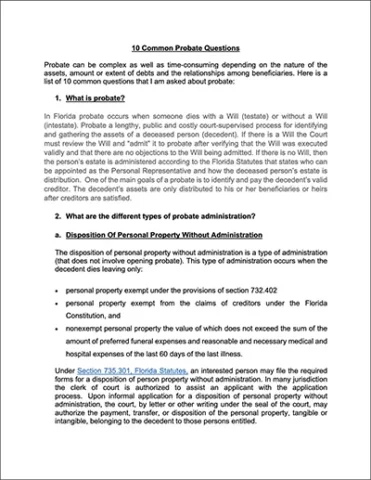
Probate Problems?
Get These 10 Common Probate Questions
Probate can be complex as well as time-consuming depending on the nature of the assets, amount or extent of debts and the relationships among beneficiaries. Get this list of 10 common questions today
Please fill out the form to download.
Areas We Serve
Carol L. Grant, P.A. serves families throughout Broward, Miami-Dade, and Palm Beach Counties. We regularly assist clients in Pembroke Pines, Miramar, Cooper City, Southwest Ranches, Fort Lauderdale, Miami, Davie, Weston, and Hollywood, along with West Palm Beach and Boca Raton in Palm Beach County. Whether you live in South Florida or you're handling Florida probate for a loved one who lived elsewhere, we can help.
Speak With a Probate Attorney in Pembroke Pines
If you've recently lost a loved one and need help with probate, or if you've been named as personal representative and don't know where to start, we can help. We offer an initial consultation to review your situation, answer your questions, and explain your options. There's no obligation, and you'll leave with a better understanding of what to expect. Call (954) 404-8274 or schedule a consultation online to get started.